
Quamplex
Developing software for music
Developing software for music
A Choke Group feature has been added to the current development branch of Geonkick. Multiple instruments can now be assigned to the same group. When one instrument in the choke group is triggered, it will silence the others. This is useful for open/closed hi-hats, layered percussion, or mutually exclusive sounds.
The choke group can be set from the kit list and will also be added to the top bar of the instrument UI. Along with implementing this feature, several DSP fixes were made, particularly to improve decay behavior when the instrument works in NOFF mode, i.e., when the instrument stops playing after the key is released.
Currently, the work is focused on updating the design of the kit list (kit tab). It should be easier to work with, allowing samples to be loaded directly into the kit. The goal is to make the Geonkick kit more convenient for users who want to use it primarily as a sample-based kit player for percussion.
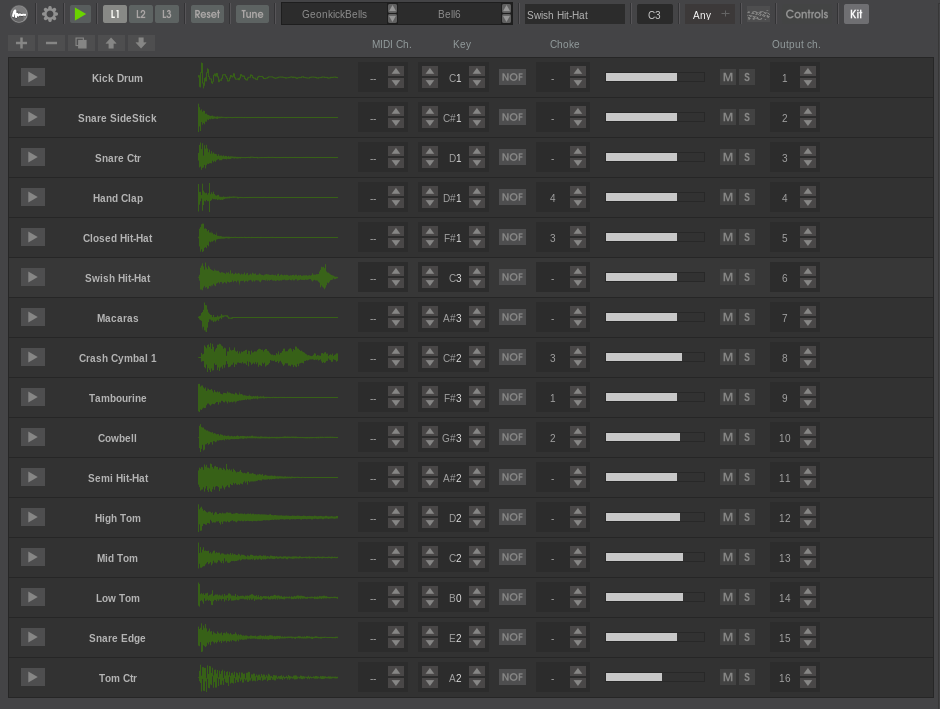
Currently, the Humanizer is accessible only from the instrument UI. I am thinking about how to make it available from the kit list as well. Additional features are also planned to gradually increase its capabilities as a sample kit player.
I’m adding a feature called “Random Gate” to the Entropictron plugin. Its purpose is to randomly silence the sound in sequences, with random intervals between them. It can also apply random gain reduction ranging from full level down to complete silence. The gate can operate in inverted mode as well, allowing random bursts of sound to appear in sequences.
The next module for Entropictron, I think, will be a bitcrusher. Recently, I’ve also been exploring various databending and datamoshing workflows — for example, using a hex editor to corrupt a sound file, or loading a JPEG or other file type as raw audio. These techniques create strange and unexpected sounds. I’m still thinking about how a workflow like this could inspire a module that is more controlled and works in real time.
Some special oscillators, acting as generators that produce unpredictable sounds, might be a useful addition too. For example, in Geonkick, varying different parameters across envelopes can generate these kinds of unusual or “weird” sounds: